PEN/Malamud Award: David Means
By Ashley Werner
The PEN/Bernard and Ann Malamud Award for Excellence in the Short Story ceremony took place on December 5, 2025, hosted by American University’s MFA in Creative Writing Program. The award this year went to David Means, who Rhonda Zimlich–Director of AU’s MFA in Creative Writing–described as “one of the most accomplished American contemporary short story writers.”
Gwydion Suilebhan, PEN/Faulkner’s Executive Director, welcomed all in attendance at the ceremony. He asked all of us to contemplate what reading and writing fiction means to us as we listened to everyone speak. Suilebhan praised the community stating that we were all there “to gather around the fire of inspiration.” I found that statement inspiring as a student of Creative Writing, because it helped me recognize that there is a whole community of fellow writers and appreciators of fiction.
David Means read his short story “The Knocking” for us, joking that he picked it because it was only a 20-minute read. Means had a way of reading his work that brought out unexpected laughs from the audience. It started out very humorous, and then as the story goes on, we start to realize that the speaker is unsure of his reality in relation to what he calls “the knocker.” The speaker projects onto the knocker his own insecurities and regrets, focusing in on the peculiarities of the knocks and what they must mean. Throughout the reading, Means embodied the speaker through body language, gesturing with one hand as one could imagine the speaker doing while telling his story. While sometimes short story readings can feel heavy and lengthy, Means had a way of both writing and reading that writing that had the audience holding on to his every word.
After the reading, Means was interviewed by Tope Folarin, a PEN/Faulkner Board Member. Folarin began the interview joking that “The Knocking” was “persistent,” then asked Means how the story came to be. Apparently, “The Knocking” was inspired by a neighbor Means had had who was a tap dancer and had a pipe organ, “or at least something that sounded like one.” They discussed how Means first studied as a poet, but never published, and later switched to short fiction. Means talked about the blurry lines between genres of poetry and short prose - how it all depends on the music of the words. On the subject of short versus long form fiction, Means compared them by saying that spending a month on a “crappy” short story is not much time wasted, but novels can take years and still be shelved. This stung a bit because it rang true for me as I am a long-form fiction writer. Writing fiction is demanding work, no matter the form, as we are still creating lives and worlds from our own thoughts.
Later in the interview, Folarin brought up the controversial topic of generative AI. Means grew more passionate as he spoke about how each human experiences life differently and how AI cannot truly replicate what a human can create because of those different experiences. AI can’t write like a human because only “I” can create it. AI can “create” things but it can never create the exact same thing that a human would because it lacks the rhetorical situation and background that writers interact with. When reading a story, “you feel the real person behind it,” said Means. He then made a joke about how soon we will need a sticker that says “100% organic fiction” to put on books written by real people. In a world filled with the panic of many writers over the rapid rise of AI and the threat that it poses for the arts everywhere, Means’ perspective was a refreshing reminder that while AI can flimsily replicate, it cannot create and truly embody the human experience as captured in art forms like writing.
Means final piece of advice for the young writers in attendance was to “find the thing you can do,” to figure out what form or genre was the most intuitive to us and pursue that as the one we’re meant to be in. For us here in the MFA at AU, this is what we strive to do throughout the program - find ourselves as writers and let it drive us passionately.
Finally, the award was presented to Means by Janna Malamud Smith, daughter of Bernard Malamud. She talked about how throughout his life, Bernard Malamud tried to master the sentence by copying down every sentence he found interesting or inspiring. Janna Malamud Smith reiterated Means’ point of how humans are the only ones who can truly generate literature. She rebuked the claim that literature exists only to teach empathy, stating that claiming literature exists for teaching empathy is like claiming nature exists for taking selfies. Smith said, “Literature can render us breathless, make us laugh, create intimacy, it leaves us less alone, and we have greater empathy for ourselves.” In essence, literature is essential to humanity.
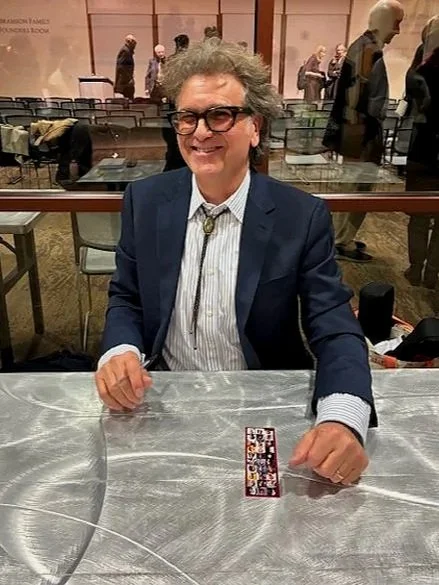
David Means accepted the award with humility, thanking the PEN/Faulkner Association and Malamud, as well as his own family and friends for supporting him through his writing career. The night ended with Means signing books while the community mingled and ate cookies, discussing their own works and literary passions.