Second-Year Spotlight: Jalisa OH
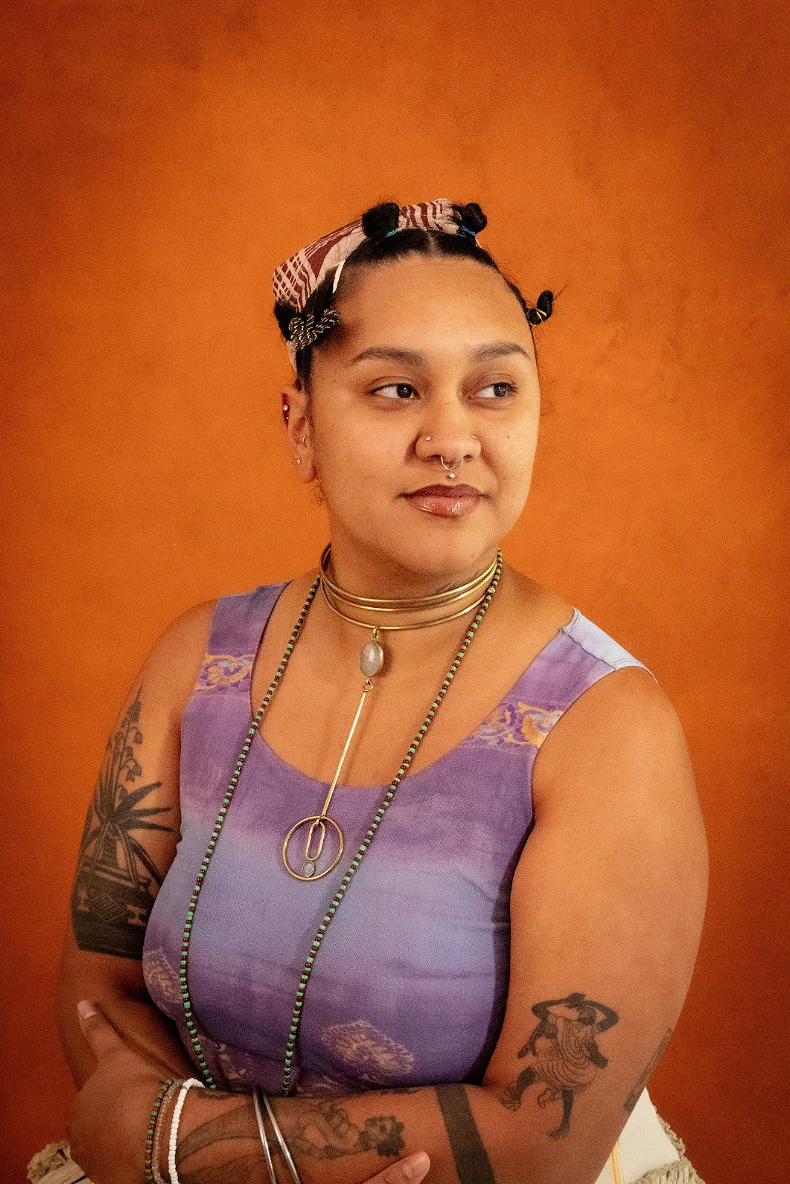
Jalisa OH is a second-year student who dabbles in many genres.
We interviewed them to learn more about their thesis project, a poetry and prose collection called Anatomy of an Eldest Daughter.
Café MFA: Introduce yourself. Who are you and what do you like to write?
Jalisa OH: My name is Jalisa Ifadunni OH. I am a sister, a lover, a daughter, an educator, a birthworker, and a multidisciplinary artist. I like to write about my spiritual practice, my relationship to my ancestors, queerness, decolonization, nature, dreams, and nightmares, which I typically do through poetry or nonfiction.
Café MFA: What is your thesis about?
Jalisa: My thesis is a collection of poetry and prose titled Anatomy of an Eldest Daughter. I’m looking at it as part prayer, part myth, part memoir. In a sense, it is self-portraiture and contains a whole lot of my business. So it’s about me.
Café MFA: Who is on your advisory board for the project? Why did you select them?
Jalisa: Kyle Dargan and Dr. Sarah Trembath. I took Poetry Workshop with Kyle in the spring and thought he was a genius, but also, I knew I wanted him on my committee before then. After learning that David Keplinger was going to be on sabbatical this semester, I wasn’t sure what to do since I’m a December graduate. Kyle recommended Dr. Trembath to me because he knew we had similar lenses in which we view the world and write from. After meeting with her, it felt perfect! I was able to meet with both of them over the summer to get jumpstarted since my timeline was a bit shorter than others’. Love my committee down.
Café MFA: How did the idea for your thesis come about?
Jalisa: It came about a few different ways. I was able to kind of solidify it in Melissa Scholes-Young’s Literary Editing and Publishing course in the spring through our book proposal project. The idea had been swimming in my head after listening to Esperanza Spalding’s album 12 Little Spells on repeat for months. Each track on the album has a corresponding body part, and I was really feeling so pulled towards exploring that in my own work. How can I write what my blood is? My heart? My mouth? And so it really took off from there. I also felt indebted to Audre Lorde’s Zami: A New Spelling of My Name, which is a biomythography that changed my life when I read it at 19. I really wanted to explore this idea of an autobiomythography through this collection.
Café MFA: What has been your biggest challenge with your thesis thus far?
Jalisa: My biggest challenge has definitely been my decision to start with an organizing principle and writing around that rather than writing and finding an organizing principle afterwards. I found myself writing other things that I liked but couldn’t quite fit into my manuscript. On the other hand, I had to let go of a lot of things I liked because it was simply too rigid and prescriptive. The biggest challenge has definitely been about finding a balance in my work and trusting the writing to lead me to where it wants to go, rather than what my vision for it might have been.
Café MFA: What has been your biggest success thus far?
Jalisa: Compiling my work together in a way that makes sense! It’s been a deeply humbling yet invigorating experience to see so much of my work in one single place. It felt daunting at first because I didn’t think I had enough material to put together, but now I find myself doing a lot more trimming and replacing.
Café MFA: What has this project taught you?
Jalisa: That my work is more connected than I thought. I have themes, motifs, and style that I didn’t really pick up on until I put it all together in a manuscript. Also, I do NOT actually work better under pressure. Also, just because conditions may not be ideal, it does not mean I need to stall the work or my process. Maybe I don’t have a cliffside a-frame house overlooking the ocean that I can write from, but I have pen & paper and that will have to suffice until I can get there.
Café MFA: What advice would you give first-year students who are planning their thesis work?
Jalisa: Write first! Keep everything! Be flexible! Compile your work and see what threads are present before settling on a title or a structure. It was helpful for me to think of structure first, but it was a barrier once I felt married to it and didn’t want to part ways with it. That is where having my committee came in handy, they were able to help me see things in different ways, despite my initial reluctance. It is true: you will have to kill your darlings.
Café MFA: Is there anything else you’d like to share with readers?
Jalisa: Support small literary journals and magazines! Like Café MFA and Folio for example ;)
Jalisa also was willing to share some of their work with us, published online in the August edition of The Acentos Review! Check out their work here: https://acentosreview.squarespace.com/jalisa-orellana-hardy
You can also find Jalisa here: http://jalisaoh.info/
As someone who has had the pleasure of being in class with Jalisa, what I’ve learned from their incredible work is the power of being vulnerable on the page and using writing as a way to examine connection - whether that connection be to ancestors, the past, memory, loved ones, community, the self, and more. Jalisa’s work is as raw as it is compelling, full of rich language and a musicality that demands attention. They do not shy away from using art as a form of resistance and catharsis, which I think is all something we can lean into as writers in a time when art is needed more than ever. We here at Café MFA are so excited to see Anatomy of an Eldest Daughter in its totality!