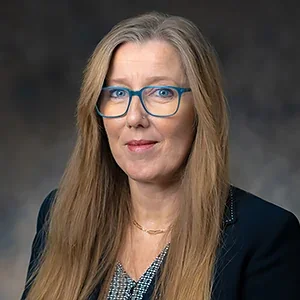
For Rhonda Zimlich, teaching creative writing is as much about curiosity and risk-taking as it is about the writing itself.
“Writing is thinking,” Rhonda Zimlich, professor and director of American University’s MFA in Creative Writing program, repeated a few times during our interview, which was sandwiched between a fireside chat she hosted on submitting work to publications (she brought pumpkin bread for all!) and the fiction workshop she teaches every Thursday night. The quote is from writer William Zinsser, but has become central to the way Rhonda approaches both writing and teaching. And while the idea certainly applies to the work we do in the MFA world, she points out that writing can be a tool for thinking through almost anything, from personal trauma in nonfiction to something as mundane as a shopping list. Even the latter, for example, can help us become more efficient with our time and money.
At the heart of this philosophy is another principle she returns to often: “Judgment is the death of curiosity.” It’s an idea that has come to inform much of her approach to the classroom, where curiosity and experimentation are not just encouraged but essential.
Rhonda’s path to teaching was not quite a straight line. It began in the early 1990s, when, after taking her first fiction writing workshop as an undergraduate in San Diego, she decided to facilitate a writers group of her own. Later, after moving to Oregon, she turned to Craigslist to find another writing community. That eventually evolved into a group of eight writers who continued meeting and workshopping together for twelve years. She joked about trying many times to pass along the responsibility of organizing the group, noting that nobody wanted her to give it up.
Around the same time, she had an opportunity to teach a workshop at the junior college level, despite not having formal teaching credentials. She was also invited to lead writing workshops at a middle school twice a week. Recognizing that she wanted to continue teaching, she decided to pursue an MFA to make that possible. She reached out to the humanities dean at the University of Oregon, who then became a mentor and helped introduce her to the graduate program.
What began as a way to qualify for teaching opportunities eventually became something much more for Rhonda. She loves being part of the workshop process, particularly because of how much she continues to learn from other writers. Characterization and dialogue, for example, are areas where she finds herself picking up new approaches and insights from her students' work. In many ways, her teaching philosophy is rooted in reciprocity: “I teach what I need to learn.” She gravitates toward teaching things she wants to understand more deeply, and notes that when she reads, she often remembers how a piece made her feel more than its specific details.
Becoming director of American’s MFA program hasn't really changed the way Rhonda teaches, but it has changed the way she thinks about sharing her work and the program with others. Meeting prospective students and newly graduated MFAs has become one of the most energizing parts of her position. She loves being around people who are actively pursuing their writing dreams, especially those making strides to bring their work to life. “I’ve been bolstered by the energy of folks having an MFA and hopefully having a book in the world, especially during such dark times,” she says. There's something contagious about being surrounded by people who share your dream, and that enthusiasm continues to give her hope.
It's clear that Rhonda genuinely loves what she does. After spending seventeen years in Oregon and growing up in San Diego, where she lived for thirty-two years, she has also come to love Washington, D.C., particularly its food scene, Metro system, and theater offerings. But her enthusiasm for American is even more apparent. “I’ve never had a job I’ve loved so much,” she says. In fact, even if she were a bestselling author, she insists she would still teach.
That affection for teaching is reflected in the environment she tries to cultivate in her workshops. Rhonda describes her style as open and comfortable, emphasizing that comfort is more important than anything else. Writing workshops require students to be vulnerable, share unfinished work, and take risks, and she wants them to feel supported in doing so. For her, risk-taking and curiosity are the two most important things writers can bring into the room. She encourages students to embrace a “yes, and” mentality rather than approaching every piece of work with the intention of tearing it apart. The goal is not to identify what isn't working, but rather to consider what is working and how it might be built upon.
She brings that same level of intentionality into her work with thesis students. Rhonda likes to read students' manuscripts in advance, ideally more than once, and prefers to provide handwritten notes alongside a typed narrative that offers broader feedback. Just as importantly, she wants to understand each student's goals before she suggests strategies for moving a manuscript forward. She often meets with thesis students before winter break to offer direction and give them something to work toward over the holiday. She told the story of one student in particular who went into break with eleven pages and returned with more than one hundred. It's a compelling example of what a little time and attention can accomplish.
When it comes to the future of writing and education, Rhonda is committed to authenticity. The rise of artificial intelligence hasn't changed her desire to write in her own voice, even if AI were somehow capable of replicating her exact milieu, form, and style. “Once you give that up, you give up your own thought process,” she explains. She approaches the question of AI in teaching with a similar sentiment. She draws on her experience running a capstone course for undergraduate seniors and working with graduate students, explaining that she isn't convinced that students are particularly interested in engaging with AI in the ways some might expect. Instead, she's noticed a growing interest in analog activities: writing by hand, crafting, painting, knitting, and even paint-by-number projects. She even recalls accidentally purchasing an AI-generated frog poster for her daughter, only to later realize what it was; her daughter encouraged her to get rid of it.
So what makes American's MFA program a good fit for prospective writers? Rhonda is very candid on this front: if an applicant has a particular niche or genre focus that would be better served by another program, she'll tell them. Some writers may be better suited to a fully funded program or one with a more specialized genre concentration. For her, recruiting students isn't about convincing someone to attend American. She wants to ensure they're making the right decision for their writing and professional goals. She believes the program speaks for itself, and encourages prospective students to come to events, meet faculty and current students, and get a feel for the community before making that decision.
Ultimately, what she hopes to build is a cohort of writers who can support one another throughout the MFA experience and beyond. Having a community of people who understand what you're trying to do and want to see you succeed is a bedrock of the MFA experience.
It's hard not to come back to Rhonda’s original idea that writing is thinking. The MFA experience is about so much more than producing pages or finishing a thesis. She reminds us that remaining curious, being willing to take creative risks, learning from the people around you, and finding the confidence to keep going are a significant part of the journey. And perhaps, most importantly, it's about being in a room full of people who share your dream.