Second Year Spotlight: Emma Sidoli
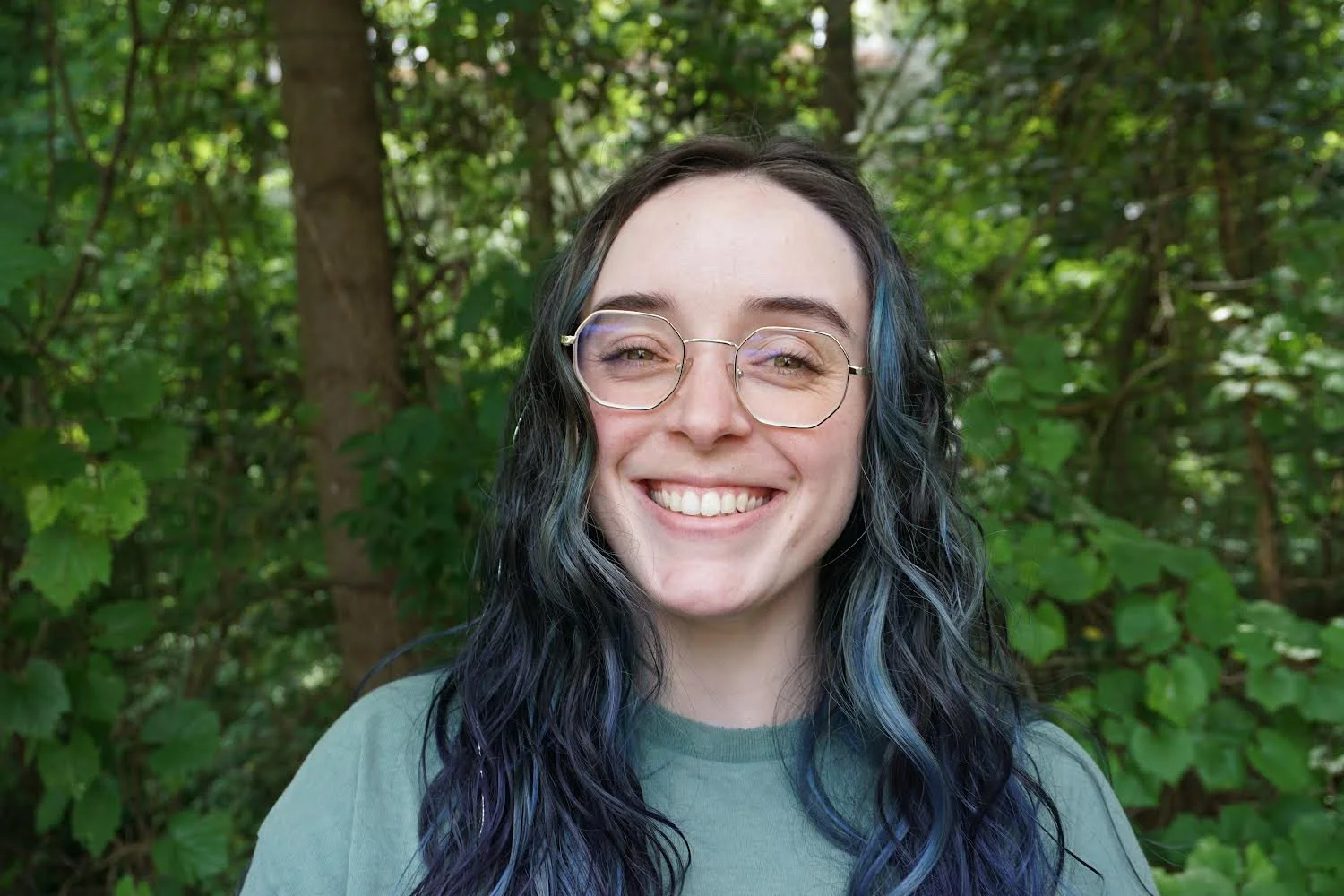
Emma Sidoli is a second-year student who writes in fiction, primarily the speculative kind.
We interviewed her to learn more about her thesis project, a short story and flash fiction collection aimed at examining womanhood.
Interview by: Hannah Cornell EIC
Café MFA: Introduce yourself. Who are you and what do you like to write?
Emma Sidoli: My name is Emma Sidoli. I'm a writer, a reader, a sometimes-editor, an aspiring educator, and a current academic publisher sales rep. I like to write in the speculative and gothic genres in women-focused fiction, often with themes of loss, queerness, and patriarchy.
Café MFA: What is your thesis about?
Emma: My thesis is a collection of speculative short stories and flash fiction focused on interrogating the ways womanhood—particularly in its roles as mother, wife, daughter, and inheritor—is constructed as an act of consumption and erasure. Across the stories, the female body becomes a site of exchange through familiar narratives of devotion and femininity and a more gothic/horror-tinged lens. Ultimately, I'm trying to explore whether identity can survive the roles imposed upon it, or whether every act of creation demands a kind of annihilation in return.
Café MFA: Who is on your advisory board for the project? Why did you select them?
Emma: Andrew Bertaina and Dolen Perkins-Valdez, because they haunt my dreams crying: "Stop over-explaining yourself, trust your reader!" and "Please, just give us some actual escalation!" And because I value their input and enjoy their company.
Café MFA: How did the idea for your thesis come about?
Emma: Partially because me and my cursed novel were simply not seeing eye-to-eye, so I decided to explore other options to make my novel jealous (it worked, she wants me back), and partially because I've had a wonderful group of speculative-friendly peers and professors surrounding me at AU that have supported me as I progressively get weirder with it. I'm not the type to jump ship without a plan b, so I started reading through the stories I'd been workshopping and discovered that quite a few had a solid thematic throughline. Putting them together was not dissimilar to puzzling in that I've only enjoyed the beginning and filling out the actual picture has been miserable.
Café MFA: What has been your biggest challenge with your thesis thus far?
Emma: My biggest challenge in all writing endeavors lies in the revision. I generally spend quite a long time writing my first drafts to try and avoid the revision step completely. Like most writers, I dislike revising my favorite stories the most, so for three of my thesis stories in particular, the journey has been a slow, careful process that's required more mental work than actual writing. I will in fact, not kill my darlings but instead relocate them to another word document that I occasionally open and reread like a dragon surveying her treasure.
Café MFA: What has been your biggest success thus far?
Emma: My biggest success was finalizing the first draft and sending it to Andrew and Dolen, fairly late in the game because I was so focused on perfecting it first - because this is actually just a necessary step in the process it can't count as a success so I will name another. My second success came in finishing the longest story in the thesis. Sitting at almost 30 pages it's my longest short story to date, and I am particularly proud of it because I almost gave up on the poor thing about half a dozen times. Shout out to "Occupants", your mother loves you and she's very sorry you were almost aborted.
Café MFA: What has this project taught you?
Emma: That I need to go back to therapy. People, if you're having trouble escalating conflict in your stories, it may just be that you're scared of it in real life.
Café MFA: What advice would you give first-year students who are planning their thesis work?
Emma: Don't be afraid to pivot. I spent my first year deeply focused on getting my novel ready for thesis submission, and I very well could have continued to focus on it. It was harder to start fresh, but my current work feels more honest and reflective of the writer I want to be. Trust yourself and talk to the writers that surround you.
I’ve taken several courses with Emma while in my time at AU and her work is often as haunting as it is impactful. Her work is incredibly masterful with poetic language that brings you into the work and keeps you from looking away. I am certain her thesis will do much of the same, asking us to open our eyes, to sit with discomfort, and to learn.
Emma was also willing to share some of her work with us! Selfishly, this is an excerpt from one of my favorite of her stories. See an excerpt below:
“You wake in the dark with milk crusted on your breasts. The baby has been feeding, though you don’t remember lifting her into your arms. Warm and damp, she sleeps in the hollow of your ribs now, her breath hot through the fabric of your nightgown.
The house is too quiet. Not the quiet of rest, but of listening. The floorboards hold their breath. Even the air is waiting.
You peel the baby away from you and lay her in the cradle. She whimpers once, a tiny bird sound, but settles. You can’t stop staring at her mouth. Pink, toothless, wet. A mouth made for consuming.
Your stomach twists.
When you carried her, you were always hungry. Even in sleep, your body burned through everything you gave it. Eggs by the dozen, leftover meat at midnight, gnawing the ends of bones until they splintered against your teeth. The doctor told you it was normal, cravings could be strange. He didn’t see you crouched in the kitchen, lapping blood and juice from the cutting board.
You try to remind yourself you are human. A mother. Not something else.
But the hunger doesn’t leave. It coils in your gut, low and steady, a second umbilical cord tethering you not to her but to what she takes from you. Every time she latches, she drains more than milk. You feel your marrow softening, your muscles loosening, like she is hollowing you out to build herself.
Tonight, you are so empty your hands shake.
You go to the kitchen. The refrigerator hums too loud, almost frantic. You open it and the light makes you squint. Chicken thighs. Leftover stew. Cold steak wrapped in foil. You tear at it with your teeth before your hands can unwrap it properly. It is gone too fast, swallowed before it hits your stomach. The hunger stays.
Your tongue aches. When you catch your reflection in the black window above the sink, you see your mouth stretched wider than it should be, lips red and raw, teeth shining slick as bone. You close your mouth quickly, but the afterimage lingers.
From the cradle, a wail.”